1. Ellipse-
"The set of all points such that the sum of the distance from two points is a constant." (Kirch)2. Algebraically, the equation of an ellipse can be either:
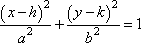
(http://www.purplemath.com/modules/ellipse.htm)
or
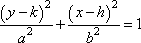
(http://www.purplemath.com/modules/ellipse.htm)
Graphically, an ellipse will look like a squished circle.

when "a" is under y^2
(http://tutorial.math.lamar.edu/Classes/Alg/Ellipses.aspx)

when "a" is under x^2
(http://tutorial.math.lamar.edu/Classes/Alg/Ellipses.aspx)
Depending on the which variable comes first, the ellipse can either be "fat" or "skinny".
Before graphing the equation of an ellipse, we must find the components to plot. The equation must be in standard form and it must equal to 1. Remember that the h and k in the equation match up with x and y value which will end up being our center point. After we identify the center, we plot it. The major axis (a) is the distance from the vertex to the center and is the longer one. The minor axis (b) is the distance between the co-vertex to the center and it is the shorter one. In a given equation, we can easily determine "a" and "b" by taking it from the denominator and finding the square root of it. The bigger number will be "a" while the smaller one will be "b".
To determine whether the major axis is horizontal or vertical, we look at the bigger number under the term. If the bigger number is under the x^2 term ,then the major axis will run horizontally. However, if it's under the y^2 term, the major axis will run vertically. Remember to note that from this information we already figured out, we can determine what the shape will look like. If the bigger number is under the x^2 term, we know that the shape will be fat and if it's under the y^2 term, it will be skinny. (X-tra FAT, Y so SKINNY) To find c, which is the distance between the focus point to the center, we use the formula a^2 - b^2=c^2. So we plug in our known terms, a and b, to find c. To plot the point for our vertices, co-vertices, and foci's we need to use all the information we were given or found. Once we find our whether our shape is fat or skinny, we can also find our major and minor axis which will either be "y=" or "x=". (These values can be found from our center point, if given!) Using the x and y values, we can put it into the corresponding spots in our vertices and co-vertices. To find the other number, we take the a or b value and find the distance from the center point.
For example, if our major axis is "y=3", we know that the line will be horizontal. So for our two vertices point, the y-values will both be 3. To find the x-value of our ordered pair, we use "a" and add it to the x-value of the center point for one of the points, then subtract the same number for the other point. Then, if our minor axis is "x=9",the co-vertices pair will have 9's in the x spots. To find out the other number of the pair, instead of using "a", we use the "b" variable and find the y-values for our co-vertices. As for "c", we keep the major axis point the same, which is 3, but for the x-value, we have to add and subtract it to our "c" variable. When we plot the points on the graph, we need to remember that the foci will be inside the ellipse, it should not go beyond the vertices.
The foci affects the shape of the conic because it can help determine whether the conic is skinny or fat. If you're still unsure whether the conic is skinny or fat, plotting the foci can be a tremendous help because we know that the foci will always lie with the major axis. So if your major axis is y, then your foci will also end up on y. We know that if "y=something" the line will be horizontal which signifies that it will be fat. Vice versa, if the major axis is "x=something" the line is vertical and the conic will be skinny. Eccentricity is the measure of the amount of how "squished" an ellipse is from being perfectly round. We find eccentricity be taking c/a. For an ellipse, the eccentricity should be 0<e<1, between 0 and 1.
For a better understanding of the components of an ellipse and a thorough example, check out this video by PatrickJMT:
3. Real world applications of ellipses
Ellipses can be found within our solar system. The sun is a focus point while the orbits in planets are ellipses. Because planets also have focus points, the orbit are elliptical. "The short answer is: it falls out of the math. Specifically, the math of first year physics and second year calculus. The fact that the Sun is in one focus is just one of those things. It’s nothing special. Even less special is the other focus, which contains nothing at all."(http://www.askamathematician.com/2010/08/q-why-are-orbits-elliptical-why-is-the-sun-in-one-focus-and-whats-in-the-other/)The chain wheel on a bike is also an example of an ellipse. Although it is slightly a little off from an elllipse, it has the elliptical shape. "Here the difference between the major and minor axes of the ellipse is used to account for differences in the speed and force applied, because your legs push and pull more effectively when the pedals are arranged so that one pedal is in front and one is in back, than when the pedals are in the "dead zone" (when one pedal is up and one pedal is down)." (http://answers.yahoo.com/question/index?qid=20061130170749AAlmTyj)
4. References/Works Cited
- http://www.purplemath.com/modules/ellipse.htm
- https://www.youtube.com/watch?v=5nxT6LQhXLM
- http://answers.yahoo.com/question/index?qid=20061130170749AAlmTyj
- http://tutorial.math.lamar.edu/Classes/Alg/Ellipses.aspx
- http://www.askamathematician.com/2010/08/q-why-are-orbits-elliptical-why-is-the-sun-in-one-focus-and-whats-in-the-other/

No comments:
Post a Comment